

I just got back from a trip to Birmingham, Michigan, where I ran an Executive Roundtable with a great group of women in business, hosted alongside JP Morgan Chase, with participation from their clients and the chair of the local Women Presidents’ Organization. Great energy, but the conversations kept circling back to the same theme: uncertainty. Businesses are still growing, but hesitation and cost increases are on everyone’s mind.
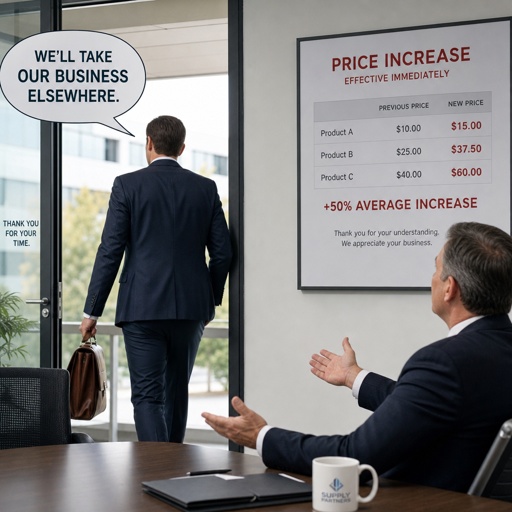
That got me thinking about a question that’s on every B2B leader’s radar right now: at what point does a price increase cost you the client?
What the consumer data says (and why it doesn’t apply to you)
A recent survey by DOSS, a consumer goods marketing software company, found that a 16% price increase is enough to make even loyal, longtime customers walk away from a brand — and 60% of loyal customers had already stopped buying from brands that raised prices by that much.
Naturally, I got curious about the B2B equivalent. But B2B doesn’t work the same way. You can’t just grab a different brand of soda off the shelf — B2B relationships are more complex and more integrated, which means the “walk-away point” looks completely different. I couldn’t find an exact percentage where B2B clients bail, but I did dig up some useful data points that shape the picture.
The B2B tariff landscape, by the numbers
Research from a global payments research firm shows that tariffs have shifted from a one-time shock in 2025 (something businesses reacted to like COVID) into an ongoing, built-in expectation. Companies have absorbed it and are now planning around it — which explains some of the more cautious buying behavior we’re seeing.
A few more data points worth knowing:
- Despite price increases, most surveyed businesses still failed to protect their margins, and demand has softened across every sector — some worse than others, but none untouched.
- On the brighter side, firms in the survey reported only a 6% decline in revenue year-over-year. Not great, but not catastrophic either.
- A 2026 KPMG tariff survey found that only 34% of the time were tariff costs actually passed through to customers by B2B companies — though that’s double what it was the year before.
- 55% of executives plan to implement further price increases.
- Nearly 70% of organizations are delaying or postponing investments as a result.
- Sourcing-related cost increases from tariffs have only driven costs up by about 26% — a smaller number than the political rhetoric around 50–150% tariffs might suggest, but still enough to meaningfully hurt margins and demand.
Bottom line: costs are climbing, you’re being priced up by your own suppliers, and you likely need to raise prices too. The real question is how you do it without losing the clients you’ve worked hard to earn — because while consumer goods customers bail around the 16% mark, B2B relationships are typically far more elastic, if you handle the increase right.
Four ways to raise your prices without losing your clients
1. Treat a price increase like market research — not an invoice update.
When I’m hired to help a company find its niche and differentiator, one of the first things we do is survey 15 decision-makers across three target industries. One of the most valuable questions I learned while launching new products for Pepsi, Pizza Hut, and Frito-Lay was simple: “At this price, would you buy a solution to this problem?” If the answer is no, the follow-up is: “What would you be willing to pay?”
That single exchange tells you your price sensitivity and gives you a real number to work toward — and it often reveals that some industries will pay double what others will for the exact same solution.
Apply the same logic to a price increase. Don’t just send a new invoice. Have conversations first. Find out who pushes back, who tries to renegotiate, and who walks. That tells you where your ceiling actually is.
2. Increase your value before you increase your price.
If the value you deliver — perceived, actual, or demonstrated — clearly outweighs the price increase, clients won’t blink. Ask yourself what your clients actually value: saving money, saving time, solving a painful problem faster, or generating more revenue or clients for themselves.
Roll out the added value first — a new program, faster turnaround, better results — and only then introduce the price increase, framed as something that comes alongside the improvement, not instead of it.
3. Segment your clients and price them differently.
Not all clients are equal, so don’t treat a price increase like a blanket policy. Separate your price-sensitive accounts from the ones who love you and can’t easily replace you — the ones with years of history, unique integration, or proprietary technology tying them to you. Price accordingly.
4. Don’t raise your prices. Renegotiate them.
Right now, 57% of procurement managers are actively renegotiating with their suppliers. Turn that dynamic around — get ahead of them. Bring options to the table before they ask: a change in scope of work, an adjustment to deliverables, or a phased rollout.
This is the same principle food and beverage brands use when they quietly resize a bag of chips instead of raising the sticker price — the value equation shifts without a blunt price hike. Look at your scope, your value differentiation, and your timing before deciding how to phase in any increase.
The one rule that ties it all together
Never raise your prices without context. Bring the full picture to the table: the added value, the phased timeline, the reasoning behind the increase. Treat it as a strategy and a conversation — a renegotiation — not a decision handed down.
Skip that step, and clients won’t argue with you. They’ll just disappear quietly, and you’ll never get the chance to win them back.
Want to reposition your messaging to grow your leads? Follow me on X, friend me on Facebook,watch my Podcast onYouTube or connect with me on LinkedIn –and let’s talk.


0 Comments