

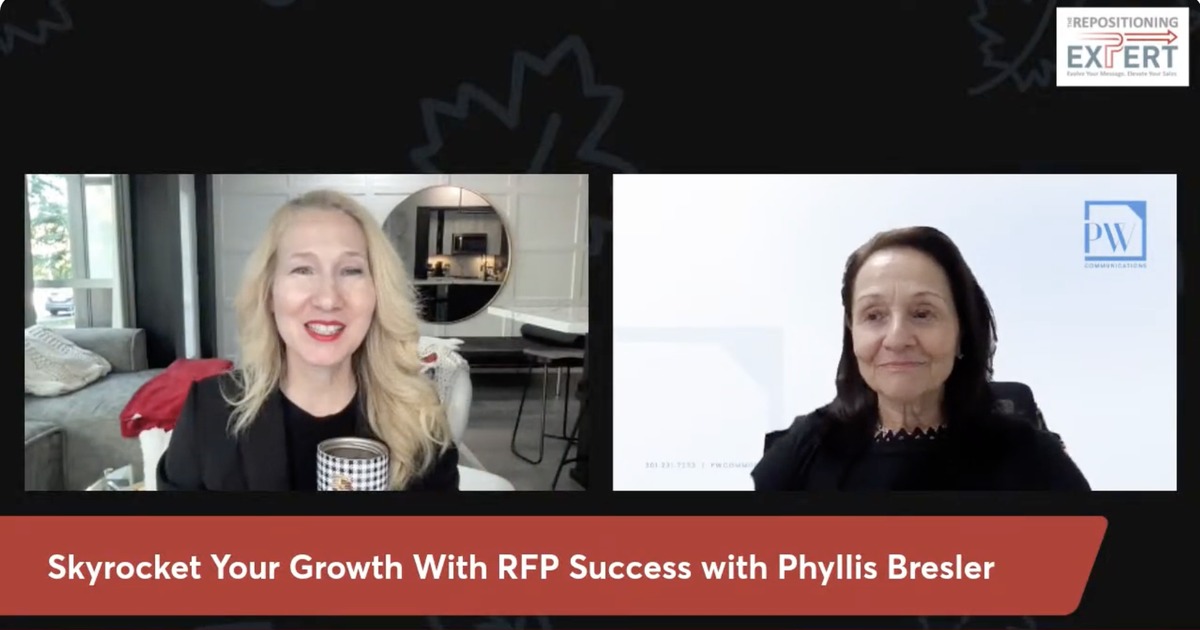
Grab your tea, because this week’s guest knows more about winning big contracts than almost anyone I’ve met.
I met Phyllis, CEO of PW Communications, at a CEO roundtable over a year ago. She was so understated that I had no idea how deep her expertise ran. When we reconnected, I told her she had to come on the show.
Phyllis founded her full-service proposal company 30 years ago and has helped companies of every size, from small businesses to the largest government contractors, respond to RFPs in the U.S. and internationally. Her favorite part? Bringing small companies to the next level.
The Interview
Chala: How did you get into the RFP business?
Phyllis: By accident. At a small company, I was basically the only person who knew how to write. I said, “We need to look professional,” and they said, “Great, you take it on.” It’s hard work, but invigorating. We put on our client’s hat and become part of their team. Our objective is simple: help you win.
Chala: What’s the hardest part of an RFP?
Phyllis: A combination of things:
- You need a lot of information at your fingertips, often from other people on their schedule.
- Deadlines don’t slip. Ever.
- You have to plan for production time. Give yourself three days to a week to make the final submission perfect. That means no more writing.
Chala: What are the biggest mistakes small businesses make?
Mistake #1: Bidding on everything.
Even the largest companies decide whether an opportunity fits before pursuing it. Ask yourself: Do I have the resources to write a proposal that is compelling, winning, and compliant? You need all three.
Mistake #2: Ignoring compliance.
A non-compliant proposal is knocked out. Done. You’re measured against the RFP’s instructions and evaluation criteria, even if you’ve heard the customer “really” wants something else. Address the requirements first, then mention alternatives as an option.
Mistake #3: Making assumptions.
Read the instructions and ask questions. RFPs are often like vegetable soup, full of acronyms. Asking for clarification is legitimate, and there’s no shame in it.
Mistake #4: Failing to differentiate.
You can’t cut and paste your marketing materials. With so many companies claiming cybersecurity, AI, or “innovation,” list what truly sets you apart before you start writing.
Chala: I tell clients to pick a specialty pain point and brand their processes around it. Does that work in RFPs?
Phyllis: Absolutely. And research the competition. Is there an incumbent? Is the customer happy with them? If the incumbent has had problems, like missing payroll, you can “ghost” that in your writing: “We are financially solid and have never missed payroll.”
Chala: Can you meet with government buyers between RFP cycles?
Phyllis: Yes. Federal agencies have small business liaisons whose job is to support small businesses. Reach out, explain what you do, and ask about their priorities for the next year or two. When your proposal crosses their desk, you’re a familiar name. Also look into set-aside programs for small, woman-owned, and minority-owned businesses and get registered.
Chala: How much does price matter?
Phyllis: It can make or break you. I’ve seen proposals rank #1 technically and #1 in management yet lose because they were the highest of 10 bidders. Today there are fewer “best and final offer” rounds, so go in with your best and final from the start.
But lowest price isn’t everything. An admiral once told a Naval Academy audience that “lowest price technically acceptable” had set her back to square one, because cheap bidders won and couldn’t deliver. If you’re not the lowest price, explain why and what extra value they get.
Chala: And AI?
Phyllis: I’m in favor of it when used properly. But check your work. Without your company’s own voice, a reviewer could read five proposals that sound identical. Reusing content is fine if it actually fits the requirement. And always get a fresh set of eyes on your proposal before it goes out.
Phyllis’s Final Advice
First impressions are lasting. A sloppy submission makes reviewers wonder if that’s how you’ll perform. With today’s technology, there’s no reason your company can’t look like a billion-dollar company.
Want to reposition your messaging to grow your leads? Follow me on X, friend me on Facebook,watch my Podcast onYouTube or connect with me on LinkedIn –and let’s talk.


0 Comments